What are the dimensions of my kitchen?
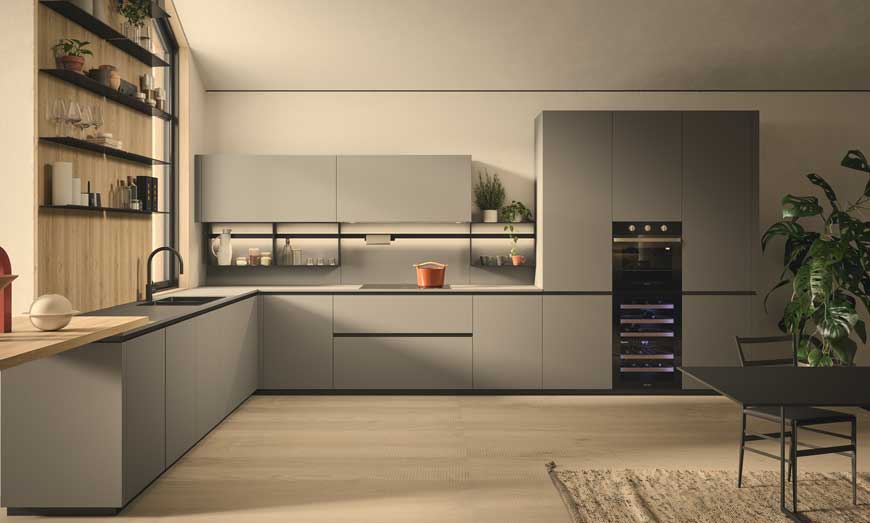
A GUIDE TO THE ESSENTIAL DIMENSIONS FOR PLANNING A KITCHEN
The height, depth and width of the cabinets determine how much space a kitchen occupies and how comfortable it is to use. When planning the layout, it is important to distinguish cabinet carcass dimensions from overall dimensions, which also include the plinth, doors and worktop.
Our essential kitchen planning dictionary explains the technical terms most commonly used in kitchen design.
the essential terms and technical language most commonly used in kitchen furnishing.

HOW HIGH ARE KITCHEN BASE UNITS?
The height of the worktop above the floor is calculated by adding three measurements: the plinth height, the cabinet carcass height and the worktop thickness.
The choice should take into account the height of the people using the kitchen and the tasks they perform. Different combinations allow the worktop to be positioned higher or lower.
Below are some examples from the Dibiesse modular range. All measurements are in centimetres.
STANDARD MODULAR RANGE
A base unit with a 12 cm plinth, a 75 cm carcass and a 4 cm worktop:
12 cm plinth + 75 cm carcass + 4 cm worktop = 91 cm overall height.
A base unit with a 15 cm plinth, a 75 cm carcass and a 4 cm worktop:
15 cm plinth + 75 cm carcass + 4 cm worktop = 94 cm overall height.
Available carcass heights:
- Base units: 18, 36, 48, 60 and 75 cm.
- Mid-height and tall units: 99, 135, 207 and 231 cm.
XL MODULAR RANGE
A base unit with a 6 cm plinth, an 84 cm carcass and a 4 cm worktop:
6 cm plinth + 84 cm carcass + 4 cm worktop = 94 cm overall height.
A base unit with an 8 cm plinth, an 84 cm carcass and a 4 cm worktop:
8 cm plinth + 84 cm carcass + 4 cm worktop = 96 cm overall height.
Available carcass heights:
- Base units: 18, 36, 48, 60 and 84 cm.
- Mid-height and tall units: 144, 204, 216 and 240 cm.
The heights listed refer to the carcasses. To calculate the overall height, the plinth and, where applicable, the worktop must also be included.
Wall-mounted base units have no plinth, allowing their installation height to be chosen according to the height of the people using the kitchen, while taking into account service connections and wall-fixing requirements.
WHICH APPLIANCE DIMENSIONS NEED TO BE CONSIDERED?
Before choosing the cabinets, check the technical specifications of the sink, hob, oven and dishwasher. The external dimensions of an appliance do not necessarily match the dimensions of the recess or cut-out required for installation.
- Sink: the sink base unit must be large enough to accommodate the bowl or bowls. Check their width and depth, allowing space for waste pipes and any internal fittings.
- Hob: check the cut-out dimensions, minimum worktop thickness and clearance required beneath the appliance, following the manufacturer’s instructions.
- Oven: a built-in model commonly described as a “60 cm oven” requires a housing whose dimensions must be checked against its technical specifications. The nominal size does not replace the installation instructions.
- Dishwasher: this generally occupies a module 45 or 60 cm wide. Height, depth and the routing of service connections must also be checked. The sink must not be positioned above the dishwasher.
WHICH DIMENSIONS DOES DIBIESSE OFFER?
- Plinths: 12 and 15 cm high for the Standard modular range; 6 and 8 cm for the XL modular range.
- Base unit carcasses: 18, 36, 48, 60 and 75 cm high for the Standard modular range; 18, 36, 48, 60 and 84 cm for the XL modular range.
- Worktops: thicknesses of 1.2, 2, 4 and 6 cm.
The curved grip profile does not change the carcass height: base units with 75 and 84 cm carcasses are available with or without it.
Between tall units, however, the curved grip profile occupies 3 cm in width. This space must be included when calculating the overall width of the composition.

HOW DEEP ARE KITCHEN BASE UNITS?
A kitchen described as 60 cm deep generally refers to the worktop depth. Dibiesse base unit carcasses are available in four depths, paired with the corresponding worktops:
| Carcass depth | Worktop depth |
|---|---|
| 33 cm | 35.6 cm |
| 43 cm | 45.6 cm |
| 57.4 cm | 60 cm |
| 67.4 cm | 70 cm |
The door thickness is added to the carcass depth. Cables run through the service void at the rear of the cabinets.
The depth should be chosen after checking the space required for the oven, hob, sink and dishwasher. A cabinet intended to accommodate them must meet their installation requirements.
A deeper worktop provides a larger working surface. Carcasses measuring 67.4 cm deep, paired with a 70 cm worktop, offer more space for food preparation.
Reduced-depth base units provide storage where a 60 cm deep composition would take up too much space. The installation of appliances or sinks must be assessed against their technical specifications.

HOW MUCH SPACE IS NEEDED BETWEEN BASE AND WALL UNITS?
Wall units are normally installed with their lower edge approximately 147–150 cm above the floor. This height is linked to the position of the cooker hood, which is generally installed approximately 60 cm above the hob, following the installation instructions provided by both appliance manufacturers.
Where there is no cooker hood, wall units can be positioned more freely to make them easier to reach and suit the needs of the people using the kitchen. Their alignment with neighbouring tall units must also be considered to maintain a consistent composition.
Please note: with induction hobs, it is important to choose a cooker hood that can also manage the steam and moisture produced during cooking. Models with anti-condensation systems help reduce the formation of droplets on the hood and nearby surfaces.

HOW DEEP CAN WALL UNITS BE?
Wall unit depth should be considered alongside the depth of the base units and worktop. It should provide storage without restricting movement during food preparation.
Dibiesse offers wall units with depths of 36 and 43 cm. The 43 cm deep wall units can be paired with 67.4 cm deep base unit carcasses and a 70 cm worktop.
The difference in depth between the wall units and the worktop leaves space in front of the upper cabinets. Comfort also depends on their installation height and the height of the people using the kitchen.

At an authorised Dibiesse retailer, you can check the dimensions of your kitchen layout, the space required for appliances and the heights best suited to everyday use.
Publication date: