Kitchen lighting: how to combine general, task and ambient lighting

Good kitchen lighting requires different types of light: general lighting to move around the room, task lighting to work on the countertop, and ambient lighting for dining or the evening. Planning them together allows you to light each area according to its use, without switching on every light.
The position of the lights should therefore follow the kitchen layout: where food is prepared, where people eat, and which areas open onto the living room.
General lighting: illuminating the room
General lighting allows you to find your way around, access cabinets and move between the different areas of the kitchen. Ceiling fixtures, recessed spotlights or other ceiling lights can provide this illumination, depending on the room’s shape and dimensions.
A single central light may leave the edges of the room less well lit. When you stand at the countertop, your body may also come between the light and the work surface, casting a shadow precisely where you are preparing food.
General lighting should therefore be complemented by dedicated lights for the working areas.
TASK LIGHTING: ILLUMINATING THE COUNTERTOP
Task lighting helps you see clearly when chopping, washing and preparing food. It should illuminate the surfaces you use while limiting shadows and distracting reflections.
Where wall units are fitted, under-cabinet lighting directs light onto the countertop. The position of the profile, the direction of the beam and the depth of the work surface all affect the result: light concentrated on the backsplash may not adequately illuminate the front edge of the countertop.
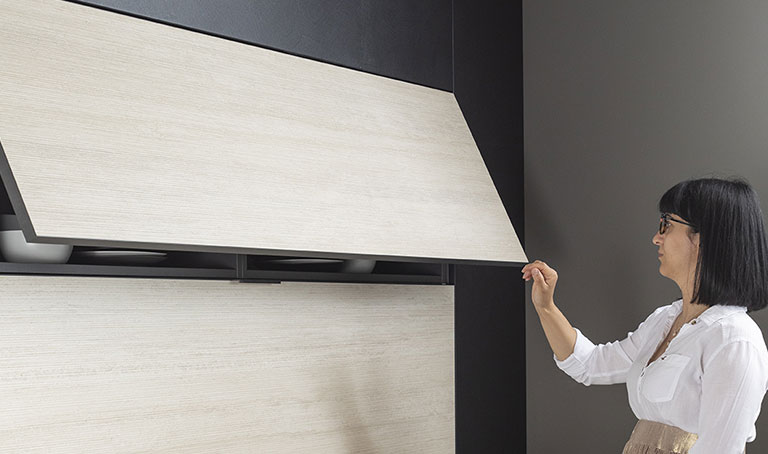
In Dibiesse handleless kitchens, LEDs can be integrated into the aluminium profile at the front of the wall unit’s bottom panel, which provides the clearance needed to open the door.
Alternatively, under-cabinet lighting can extend across the entire underside of the wall unit, form a line of varying length, or consist of a single light point. Linear profiles can be positioned centrally or closer to the wall: their position changes both the distribution of light across the countertop and its effect on the backsplash.
When choosing a solution, consider the entire preparation area. Extractor hood lighting, for example, is intended for the hob and does not replace the lighting needed on adjacent surfaces.

Ambient lighting: for dining and the evening
Ambient lighting allows part of the kitchen to remain illuminated when it is not being used for cooking. It is particularly useful in open-plan spaces, where the kitchen remains visible while people relax or talk in the living area.
An illuminated glass-fronted cabinet, a shelf with integrated lighting or an indirect light source can highlight part of the kitchen. The brightness should suit the setting, avoiding glare for anyone sitting at the table or on the sofa.
The same light can serve more than one purpose: dimmable under-cabinet lighting can also contribute to the room’s atmosphere when used at a lower brightness.
ILLUMINATED BACKSPLASHES AND BACK PANELS FOR GLASS-FRONTED CABINETS
Dibiesse offers illuminated panels that can be installed between the countertop and the wall units or inside glass-fronted cabinets.
Between the countertop and wall units, an illuminated backsplash creates a luminous surface along the working area. Its contribution to countertop lighting should be assessed as part of the design: check whether it adequately illuminates the preparation areas and whether additional task lighting is needed.
Inside glass-fronted cabinets, an illuminated back panel highlights the contents and adds another light source to the kitchen, which can also be used when the other lights are switched off.

How to light an island, peninsula or dining table
The choice depends on how the surface is used. An island used for food preparation needs light on the worktop, while a peninsula used for dining should also provide comfortable lighting for those seated around it.
Pendant lights should be positioned in relation to the surface they need to illuminate. Their height, number and spacing depend on the dimensions of the surface and the characteristics of the fixtures. They should avoid glare and allow clear views between people.
If an extractor hood is installed above the island, its size and position should also be considered when arranging the lights.
WARM OR NEUTRAL LIGHT:WHICH SHOULD YOU CHOOSE?
Colour temperature describes the appearance of light and is expressed in kelvin, using the symbol K. Values such as 2700–3000 K correspond to warm light, while light at around 4000 K is commonly described as neutral.
Colour temperature does not indicate how much light reaches the countertop. Warm light can adequately illuminate a work surface if the fixture is correctly selected and positioned.
Consider together the light sources that will be switched on at the same time, especially in kitchens that open onto the living area. Colour rendering should also be taken into account: this describes how faithfully a light source reveals the colours of objects and affects the appearance of food, materials and finishes.

Lighting inside pantry units, drawers and deep drawers
Interior lighting makes it easier to find objects inside cabinets. With an opening sensor, the light switches on when the door or drawer is opened.
Lights and shelves should be planned together. Inside tall units, glass shelves allow light to pass through, while opaque shelves can block it and may require a different arrangement of light sources.


How to switch on and adjust kitchen lighting
Kitchen lights can have dedicated controls or be connected to the controls for other light sources. This choice should be made during the design stage, according to how the different areas will be used.
AUTOMATIC LIGHTING WHEN CABINETS ARE OPENED
Lights inside cabinets, tall units, drawers and deep drawers can be fitted with sensors that switch them on automatically when the cabinet is opened. In storage units fitted with a motion sensor, the light switches on when movement is detected.
Spotlights with integrated switches are also available, allowing the light to be switched on and off manually.
DEDICATED CONTROLS OR CONNECTIONS TO A ROOM LIGHT SWITC
LED profiles fitted outside cabinets, such as under-cabinet lights, can have a dedicated control or be configured to switch on together with other kitchen lights through a wall switch.
Separate controls allow you, for example, to illuminate the countertop without switching on the general lighting, or to leave only the ambient lights on.
The connection should be agreed with the electrician and checked against the specifications of the selected fixtures. For the solutions described here, LED profiles must be left in the “on” position using their own control if they are to be operated through the main light switch.
ADJUST BRIGHTNESS
Dimming allows you to change from brighter to softer light. On LED profiles equipped with this function, brightness is adjusted by pressing and holding the power button.
The same under-cabinet light can therefore illuminate the countertop during food preparation and contribute to the kitchen’s atmosphere when used at a lower brightness.
EMOTIONAL DUAL COLOR TECHNOLOGY
Solutions featuring Emotional Dual Color technology allow both brightness and colour temperature to be adjusted, moving gradually from warm light at 2700 K to neutral light at 4000 K.
This allows the light’s appearance to be coordinated with other light sources in the room, selecting the combination of brightness and colour temperature that best suits the activity.

When should kitchen lighting be planned?
Lighting should be planned alongside the cabinet layout, before the electrical provisions are completed.
At this stage, the positions of lights, sockets and controls are established, together with the locations of power supplies and cables. Components that may require maintenance should remain accessible.
When planning the kitchen with your retailer, explain which surfaces will be used for food preparation, where you will eat, and how the kitchen will be used alongside adjacent rooms. This information helps determine the position, purpose and controls for each light.
UPDATED OCTOBER 2026
Sources
LED Basics — U.S. Department of Energy
Understanding LED Color-Tunable Products — U.S. Department of Energy
Publication date: